Top Air Cooled Scroll Chiller Manufacturer Advances Efficient HVAC Solutions
FOSHAN, GUANGDONG, CHINA, October 10, 2026 /EINPresswire.com/ -- As commercial buildings, industrial facilities, and
Press Release Disclaimer: This is a press release distributed through the XPR Media network. It has not been independently verified by our newsroom.

FOSHAN, GUANGDONG, CHINA, October 10, 2026 /EINPresswire.com/ —
As commercial buildings, industrial facilities, and specialized production environments place greater emphasis on reliable temperature control, the demand for adaptable heating, ventilation, and air conditioning (HVAC) systems continues to grow. Guangdong Head-Power Air-Conditioning Co., Ltd. is a manufacturer of central air conditioning and refrigeration equipment serving a wide range of building and industrial applications. Based in Foshan, Guangdong Province, China, the company develops and supplies cooling, heating, and air treatment solutions, including air-cooled scroll chillers, water-cooled chillers, and integrated air conditioning systems. Its product portfolio reflects the varied requirements of contractors, engineering companies, equipment distributors, and end users seeking HVAC systems tailored to their operating conditions.
Modern cooling projects involve more than selecting equipment with an appropriate nominal capacity. Engineers must consider ambient temperatures, operating schedules, installation space, energy consumption, maintenance access, noise levels, and the performance required under changing loads. The choice of chiller technology can influence both the initial installation and the long-term operation of a facility. Against this background, Guangdong Head-Power Air-Conditioning Co., Ltd. offers multiple refrigeration and air conditioning product categories to help customers compare solutions for different applications.
Air-Cooled Scroll Chillers Support Flexible Cooling Applications
Air-cooled scroll chillers are widely used in commercial and industrial cooling systems because they reject heat directly to the outdoor air and generally do not require a separate cooling tower. This configuration can simplify installation for projects where water availability, plant-room space, or the cost of additional cooling-water infrastructure is a concern.
A typical air-cooled chiller circulates refrigerant through a refrigeration cycle to remove heat from water or another compatible fluid. The chilled fluid is then distributed to air handling units, fan coil units, process equipment, or other terminal devices. Heat absorbed from the building or process is ultimately released through the air-cooled condenser.
Scroll compressors are frequently used in small and medium-capacity refrigeration systems because of their compact design and relatively smooth operation. Depending on the equipment configuration, multiple compressors may be arranged to provide staged capacity control. This can help the system respond to variations in cooling demand rather than operating continuously at full output.
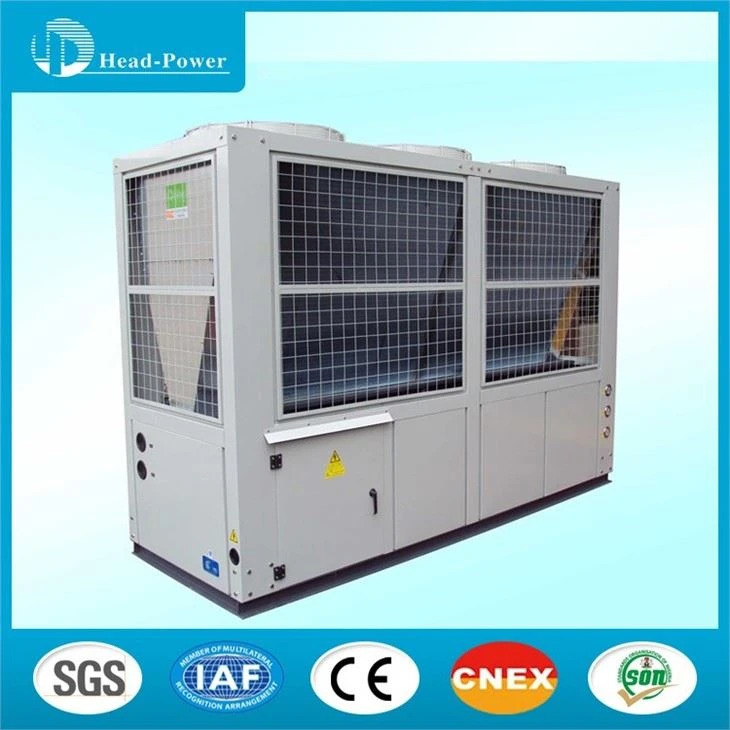
Guangdong Head-Power Air-Conditioning Co., Ltd. offers an Air Cooled Scroll Chiller range designed for commercial and industrial applications. The company’s published product information highlights features such as scroll compressor technology, intelligent control, remote monitoring capabilities on applicable models, and options intended to support different operating conditions. Buyers should confirm the specific functions and technical ratings available on the model under consideration.
For hotels, restaurants, office buildings, retail spaces, and selected industrial facilities, an air-cooled scroll chiller may provide a practical means of centralizing cooling production. The suitability of the equipment depends on the required cooling capacity, design temperatures, operating hours, outdoor climate, and the configuration of the building’s chilled-water distribution system.
When comparing chiller options, engineers should review more than the headline capacity. Important parameters include the rated cooling output, energy efficiency under relevant test conditions, compressor configuration, refrigerant type, water-side pressure drop, control functions, and operating limits. These details help determine whether a system can meet the demands of the intended application.
Energy Efficiency and Part-Load Performance Matter
Cooling demand in many buildings changes throughout the day and across seasons. A commercial facility may experience high loads during peak occupancy but require substantially less cooling during quieter periods. Industrial processes can also experience fluctuations depending on production schedules and equipment utilization.
For this reason, part-load performance is an important consideration when evaluating chillers. A system that operates efficiently across a range of loads may offer advantages over equipment selected solely for peak-demand conditions. Compressor staging, electronic controls, heat exchanger design, and the coordination of pumps and terminal equipment can all influence overall system performance.
Guangdong Head-Power Air-Conditioning Co., Ltd. supplies refrigeration equipment for projects with different capacity and operating requirements. Depending on the selected product, customers may evaluate control systems designed to coordinate cooling output with demand and support equipment monitoring. Remote monitoring functions, where provided, can also help operators review operating conditions and identify abnormal behavior.
Actual energy consumption depends on the complete installation rather than the chiller alone. Water flow rates, chilled-water temperature settings, condenser cleanliness, refrigerant charge, pump selection, and the performance of the connected air conditioning system can all affect operating efficiency. Correct commissioning and regular maintenance are therefore essential to achieving the expected results.
Facility managers should also consider the local climate. High outdoor temperatures can affect air-cooled condenser performance and available cooling capacity. In regions with demanding summer conditions, it is important to confirm that the selected unit is designed to operate within the project’s expected ambient-temperature range.
For procurement teams, comparing equipment using consistent performance conditions can make supplier evaluations more meaningful. Capacity, efficiency, noise, and operating limits should be assessed against the same design assumptions, while any optional features should be clearly distinguished from the standard configuration.
Water Cooled Chiller Systems Offer Another Route to Central Cooling
Although air-cooled chillers are suitable for many installations, water-cooled systems remain an important option for projects with different capacity, efficiency, and infrastructure requirements. A water-cooled chiller typically transfers heat from the refrigerant to condenser water, which then releases that heat through a cooling tower or another suitable heat-rejection arrangement.
The choice between air-cooled and water-cooled equipment depends on several factors. Water-cooled systems may offer advantages in certain larger installations or projects with suitable cooling-water infrastructure. However, they generally require additional equipment, water management, maintenance, and space for components such as cooling towers and pumps. Air-cooled systems may reduce this infrastructure requirement, although their performance is more directly influenced by outdoor air conditions.
Guangdong Head-Power Air-Conditioning Co., Ltd. also provides Water Cooled Chiller products as part of its wider refrigeration portfolio. Its published product categories include water-cooled scroll and screw chiller systems, as well as modular cooling solutions. These options allow customers to assess different equipment configurations according to project scale, operating conditions, and engineering specifications.
Water Cooled Chiller systems are commonly considered for large commercial buildings, industrial facilities, and projects where centralized cooling serves multiple zones or process loads. The final selection should account for the cooling demand profile, the available plant-room arrangement, local water conditions, energy costs, and the maintenance resources available to the operator.
Water quality is a particularly important factor in water-cooled installations. Appropriate treatment and monitoring can help manage scaling, corrosion, and biological growth in the relevant water circuits. Cooling towers also require proper maintenance and water management procedures. These operational responsibilities should be included in the project evaluation rather than considered only after installation.
For engineering contractors, coordinating the chiller with pumps, heat exchangers, cooling towers, pipework, and control systems is central to reliable operation. Correct equipment sizing and system balancing can help prevent unnecessary energy consumption and support stable chilled-water delivery.
By offering both air-cooled and water-cooled chiller categories, Guangdong Head-Power Air-Conditioning Co., Ltd. gives project teams alternatives to review when developing central cooling solutions. The final decision should be based on a complete technical and economic assessment of the installation.
Air Conditioning Solutions for Commercial and Industrial Environments
Chillers are only one component of a complete HVAC installation. Air conditioning equipment is responsible for delivering conditioned air to occupied spaces or controlled environments, helping manage temperature and, depending on system design, humidity, ventilation, and air distribution.
Different buildings have different environmental requirements. Hotels and offices often prioritize occupant comfort, dependable operation, and manageable noise levels. Factories may require cooling systems that can handle process heat or demanding operating schedules. Laboratories, equipment rooms, and other specialized facilities may require closer control of temperature and humidity, depending on the application.
Guangdong Head-Power Air-Conditioning Co., Ltd. supplies Air Conditioning products across several equipment categories. Its portfolio includes air handling units, fan coil units, rooftop packaged units, ducted split systems, precision air conditioners, dehumidifiers, and heat recovery fresh air handling equipment. These product categories can be considered for projects ranging from general commercial comfort cooling to more specialized air treatment applications.
Air handling units and fan coil units can be integrated with chilled-water systems to distribute cooling throughout a building. Rooftop packaged units combine major air conditioning components in a single assembly, which may be suitable for selected commercial and industrial installations. Precision air conditioning equipment is designed for environments where temperature control requirements are more specific than those typically found in ordinary occupied spaces.
Selecting suitable Air Conditioning equipment requires attention to airflow, cooling capacity, external static pressure, filtration requirements, humidity control, available installation space, and the expected operating schedule. The interaction between air conditioning equipment and the central chiller system is also important. If terminal equipment is poorly sized or the chilled-water system is incorrectly balanced, overall performance may be reduced even when the chiller itself is appropriately selected.
Ventilation should also be considered as part of the wider HVAC design. In buildings where outdoor air requirements are significant, fresh air handling and heat recovery may help support indoor air quality while managing the energy associated with conditioning incoming air. The appropriate solution depends on building use, climate, occupancy, and applicable ventilation requirements.
Supporting Equipment Selection and Project Planning
HVAC procurement often involves multiple stakeholders, including consultants, contractors, distributors, facility owners, and maintenance teams. Each group needs reliable information to evaluate equipment and coordinate its role within the project. Manufacturers that provide clear technical specifications and responsive engineering communication can help reduce uncertainty during the selection process.
Guangdong Head-Power Air-Conditioning Co., Ltd. describes its business as covering the design, production, and sale of central air conditioning and refrigeration equipment. Its company information identifies a manufacturing facility in the Nanhai District of Foshan, Guangdong Province, and describes technical capabilities related to product development and testing.
For customers planning a chiller installation, the initial evaluation should establish the required cooling capacity and design operating conditions. Engineers should review the heat load, chilled-water supply and return temperatures, expected flow rates, ambient conditions, and any constraints involving noise or equipment placement. The project team should also clarify electrical supply requirements, control interfaces, piping connections, and maintenance access.
Customization may be relevant when standard configurations do not match a project’s dimensions, environmental conditions, or operational requirements. Before placing an order, buyers should confirm which specifications can be modified, what engineering information is required, and whether the proposed configuration has been evaluated for the intended conditions.
Quality documentation and compliance information are additional parts of the procurement process. The company references ISO quality and environmental management systems and CE-related certification information on its website. Buyers should verify the current validity and scope of applicable certificates and confirm the compliance requirements relevant to the specific product and destination market.
After-sales service should also be included in the selection criteria. Installation guidance, commissioning support, troubleshooting procedures, spare-parts availability, and maintenance documentation can affect the practical value of HVAC equipment over its operating life. Buyers should clarify the service arrangements before finalizing a purchase, particularly for projects where cooling continuity is essential.
The Outlook for Chiller and HVAC Technology
The HVAC industry continues to respond to demands for energy-conscious building operation, improved control, and more flexible system integration. Chillers and air conditioning equipment are central to these efforts because they influence energy consumption, occupant comfort, and the operating conditions of industrial processes.
Air-cooled scroll chillers can provide a practical option for projects seeking centralized cooling without a separate cooling tower. Water-cooled chillers offer an alternative for installations where water-based heat rejection and associated infrastructure are appropriate. The choice between them depends on the specific requirements of the building or process rather than on a single universal measure of performance.
Guangdong Head-Power Air-Conditioning Co., Ltd. serves this market through a portfolio covering Air Cooled Scroll Chiller systems, Water Cooled Chiller equipment, and Air Conditioning products. Its broader range gives buyers several categories to consider when coordinating central cooling, air distribution, and specialized environmental control.
For prospective customers, the most effective purchasing process begins with a clear assessment of the application and a comparison of verified technical specifications. Reviewing performance data, confirming operating limits, planning maintenance, and coordinating equipment with the wider HVAC system can help support dependable long-term operation.
As cooling requirements become more varied across commercial and industrial sectors, manufacturers that offer a broad equipment portfolio and clear technical communication can provide useful options for contractors and system designers. The final outcome, however, depends on selecting, installing, commissioning, and maintaining the equipment according to the demands of each project.
About Guangdong Head-Power Air-Conditioning Co., Ltd.
Guangdong Head-Power Air-Conditioning Co., Ltd. is a manufacturer of refrigeration and air conditioning equipment based in Foshan, Guangdong Province, China. The company focuses on the design, production, and supply of central HVAC systems for commercial and industrial applications. Its product portfolio includes Air Cooled Scroll Chiller systems, Water Cooled Chiller equipment, air conditioning units, heat pumps, air handling units, fan coil units, rooftop packaged units, precision air conditioners, dehumidifiers, and heat recovery ventilation equipment. The company also describes its capabilities as including product development, testing, and technical support for different cooling and air treatment requirements. Its equipment can be evaluated for applications in factories, schools, hotels, shopping centers, and other commercial or industrial environments. For more information about its product range, technical specifications, and project support, visit www.headpowerac.com.
Address: Shiling Chenbian Section, 321 National Highway, Shishan Town, Nanhai District, Foshan, Guangdong, China.
Official Website: https://www.headpowerac.com/
Cindy
Guangdong Head-Power Air-Conditioning Co., Ltd.
info@china-headpower.com
Legal Disclaimer:
EIN Presswire provides this news content “as is” without warranty of any kind. We do not accept any responsibility or liability
for the accuracy, content, images, videos, licenses, completeness, legality, or reliability of the information contained in this
article. If you have any complaints or copyright issues related to this article, kindly contact the author above.

Media gallery